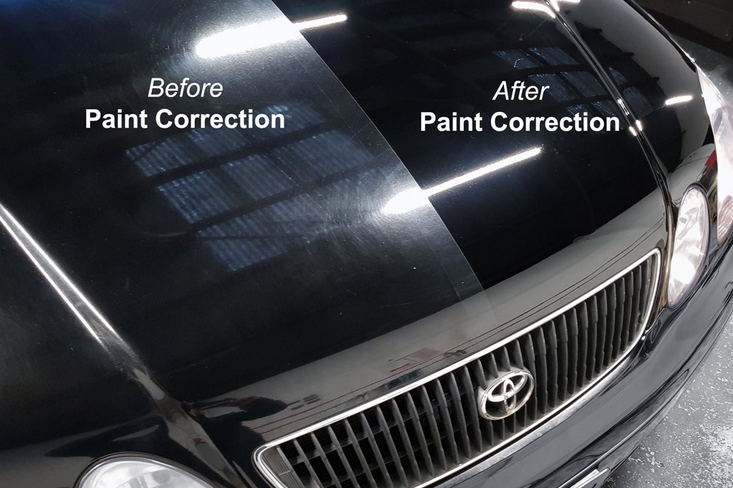
If the damage sits within the clear coat, such as swirl marks, light scratches, water marks or surface oxidation, paint correction can usually remove it and keep your factory paint. If the clear coat is peeling, or a scratch or chip has gone through to the colour, primer or metal, the panel needs paint repair or a respray.
Plenty of Perth owners assume their tired-looking paint needs a respray when it doesn’t, and a few hope polishing will save paint that has already failed. Working out which group you’re in before you get quotes saves time, money and disappointment.
How is paint correction different from a respray?
Most modern car paint has three layers: primer on the metal, a base coat that provides the colour, and a clear coat on top that gives gloss and protection. Nearly all everyday damage starts in that top clear layer.
Paint correction is machine polishing. It removes a microscopically thin amount of clear coat to level the surface, so the edges of scratches and swirls disappear and light reflects evenly again. Nothing is added; the original paint stays.
A respray replaces paint. A panel shop sands the damaged area back, repairs anything underneath, then applies new colour and new clear coat, usually blending into neighbouring panels so the colour matches.
| Paint correction | Respray | |
|---|---|---|
| What it does | Levels defects within the existing clear coat | Replaces paint on a panel or the whole car |
| Typical fixes | Swirls, light scratches, water spots, light etching, dullness | Peeling clear coat, deep scratches, chips, rust, panel damage |
| Original factory paint | Kept | Replaced on the panels that are painted |
| Colour matching | Not needed | Needed, often with blending |
| Who does it | A paint correction specialist | A panel and paint shop |
How can you tell which one your paint needs?
You can get a good idea at home before anyone looks at the car. Wash and dry it first, as dirt hides a lot.
Try the fingernail test
Run a fingernail gently across the scratch. If your nail glides over it, the scratch is very likely within the clear coat and a good candidate for correction. If your nail catches, it may be deeper. Some of these can still be improved a great deal, but they may not disappear completely.
Look at the colour inside the scratch
A fine white or light line on dark paint is usually a clear coat scratch. If you can see a different colour in the groove, such as grey primer or shiny metal, the scratch has gone through the paint and correction alone won’t fix it.
Check the roof, bonnet and boot lid
Clear coat failure shows up first on horizontal panels that face the sun all day. It starts as a cloudy, milky patch and then begins to flake or peel, often in sheets. Cars that have spent years parked outside in Perth are prone to it. Once the clear coat is lifting, there’s nothing left for a polisher to work with.
Look closely at faded or chalky paint
Paint that looks dull and chalky is not always finished. Sometimes the oxidation is only on the surface, and a small test area polished by a professional will show whether gloss comes back. If the test patch stays flat or the clear coat is thin, the panel is beyond correction.
Why keep factory paint if you can?
When correction is possible, it’s usually worth choosing over a respray, for a few practical reasons:
- Consistency. Factory paint is applied and baked under tightly controlled conditions that are hard to replicate on a single panel.
- Colour. Metallic, pearl and multi-layer colours are notoriously tricky to match perfectly, especially in strong sunlight.
- Resale. Buyers and inspectors often check paint thickness with a gauge. Resprayed panels can prompt questions about accident history, even when the work was purely cosmetic.
- Time off the road. Paint correction at Trident typically takes 1-3 days. Panel work often takes longer once preparation, painting and curing are included.
When is a respray the only real fix?
Correction removes defects within the clear coat only. It cannot add back paint that is missing or failing. A panel shop is the right call when you see:
- Clear coat that is flaking, peeling or crazed
- Scratches that show primer or bare metal
- Stone chips that have taken paint off (small ones can sometimes be touched up)
- Rust bubbling under the paint
- Dents, creases or cracked bumpers
- An earlier respray that is failing or has visible defects
Can you combine the two?
Often, yes, and it’s a common way to get a car looking even again. One or two damaged panels go to the panel shop, and the rest of the car is corrected so the gloss is consistent from front to back. New paint needs to cure fully before it is machine polished or protected, so ask the panel shop how long their paint system needs.
Once the paint is right, protecting it stops the cycle starting again. A ceramic coating makes washing easier and helps resist etching from droppings and sap, while paint protection film takes stone chips and scuffs on the front end and high-wear areas.
What does paint correction involve?
Paint correction at Trident is a three-stage process: cut, polish and finish. The cutting stage removes the heavier defects, polishing refines the haze left behind, and the finishing stage brings out the final depth and gloss. How aggressive each stage needs to be depends on how deep the defects go.
Because clear coat is thinner than a sheet of paper, correction isn’t something to repeat every year. Each session removes a little material, so it makes sense to correct properly once and then protect the result. If swirls are your main concern, our article on swirl marks on car paint explains how they form and how to stop them coming back.
What affects the cost?
Without seeing the car, nobody can give a fair figure for either job, but the main drivers are easy to understand.
For paint correction, cost depends on the size of the car, how hard or soft the paint is, how deep the defects go and how many stages are needed. For a respray, it depends on how many panels are involved, the colour and finish, any repairs underneath, and how much blending is needed to make the colour match.
Frequently asked questions
Can paint correction fix peeling clear coat?
No. Once clear coat has started to peel or flake, polishing can’t rebuild it. The affected panel needs to be repainted.
Is paint correction safe on an older car?
Usually, as long as enough clear coat remains. Paint thickness can be checked before polishing so the work stays within safe limits.
Will a resprayed panel look different from the rest of the car?
It can, particularly if the original paint has faded or dulled. Correcting the panels around it helps the gloss sit closer to the new paint.
Can I put PPF or a coating on fresh paint straight away?
Not straight away. The new paint needs time to cure first, and the panel shop can tell you how long their paint system requires.
Get your paint assessed
Not sure whether your paint can be saved? Bring the car to 45 Berriman Drive, Wangara or Unit 6/1780 Albany Highway, Kenwick, or call 0482 689 885. You can also see examples of finished cars on our work page.