Factory privacy glass mostly darkens the view into the car rather than stopping heat. The colour is built into the glass and is usually fitted only behind the front doors, so the driver’s and front passenger’s windows stay clear. Adding a ceramic window film brings infrared heat rejection and stronger UV protection while staying within WA’s legal limits.
Lots of SUVs, utes and people movers sold in Perth come with dark rear glass straight from the factory. It looks like tint, so it’s natural to assume the job is done. Climb in after the car has sat in a Joondalup or Armadale shopping centre car park on a 38-degree afternoon, though, and you’ll often find the cabin is just as hot as any other car. Here’s why, and what film adds.
What is factory privacy glass?
Privacy glass is coloured during manufacture, with pigment mixed through the glass itself. There’s no film on the surface, so it can’t peel, scratch off or bubble. Car makers usually fit it to the rear door windows, rear quarter windows and tailgate, and leave the front side windows and windscreen clear.
Its main job is the one in the name: privacy. It cuts the amount of visible light passing through, which makes it harder to see passengers, bags and tools inside.
Does privacy glass block heat?
Some, but less than many owners expect. Much of the sun’s heat arrives as infrared energy, which you feel rather than see. Darker glass absorbs part of it, but the glass then warms up and passes that heat into the cabin. How much infrared a particular car’s privacy glass stops varies by manufacturer, and it’s rarely a figure owners are given.
Ceramic tint is built specifically to reject infrared. Rayno Phantom S9 film, for example, offers infrared rejection of up to 93%. That’s why a car with privacy glass and ceramic film can feel noticeably cooler than one with privacy glass alone, even if the two look almost the same from outside.
What about UV protection?
Windscreens are laminated and block most UV. Side and rear windows are generally toughened glass, which lets more through, and tinted glass on its own doesn’t guarantee strong UV protection. The WA Department of Transport’s window tinting bulletin notes that any film, tinted or clear, attached to the glass will usually reduce the UV passing through to less than 1%. Rayno Phantom film offers up to 99.9% UV rejection, which helps protect skin, seats and trim.
Privacy glass vs window film at a glance
| Factory privacy glass | Ceramic window film | |
|---|---|---|
| Where it’s fitted | Usually rear windows only | Any window allowed under WA rules, including the front sides |
| Main benefit | Privacy and reduced glare | Heat rejection, UV protection, privacy and glare |
| Infrared heat | Varies, often modest | Rayno Phantom S9 up to 93% |
| UV | Varies with the glass | Up to 99.9% with Rayno Phantom |
| Can it change later? | No, it’s part of the glass | Yes, film can be removed and replaced |
Why do the front windows matter most?
Privacy glass protects the back seat, but the driver sits beside clear glass. On a long drive with the sun coming through the side window, that’s where your arm and face cop the heat and UV. In WA the front side windows must have at least 35% visible light transmission, so they can’t be made dark. A ceramic film at a legal shade can still cut a large share of the heat without making the glass hard to see through, which is often the biggest comfort gain on a car that already has privacy glass in the back.
Can you put tint over privacy glass?
Yes. Film goes on the inside of the glass, whether the glass is clear or factory tinted. The catch is that the legal limit applies to the glass and film together. Behind the front doors, WA allows a combined reading as low as 20%, provided the vehicle has exterior mirrors on both sides. Because privacy glass already blocks a lot of light, adding a dark film over it can push the total below that figure.
Where factory privacy glass is already below 20%, the Department of Transport’s bulletin says an exemption may be granted, case by case, to fit film that matches the existing glass. No exemption is granted for the front windows. For a worked example on a popular family SUV, see our Toyota RAV4 window tint guide, and for the rules in full, our page on window tinting laws in Australia.
Getting the front and back to match
A common goal is a car that looks even from the side. Since the front glass can’t go below 35%, the rear will often still look darker. A lighter film over the rear privacy glass can add heat and UV rejection without making the back any darker, while a legal film on the front narrows the gap in appearance. Trident fits WA-legal shades.
Who gets the most from adding film?
- Drivers who spend long stretches on the road with the sun on the driver’s side
- Families with young children or older passengers in the back on hot days
- Cars parked outdoors at work all day, where the cabin and dash bake
- Owners who want the front windows to look closer to the factory-dark rear
If you only want a little more privacy and your car is mostly garaged, factory glass on its own may be enough. If comfort in summer is the priority, film is where the difference lies. Our window tinting page covers the films available, from ceramic and carbon to dyed.
Frequently asked questions
Is privacy glass the same as window tint?
No. Privacy glass is coloured during manufacture, while window tint is a film applied to the inside of the glass afterwards. They can look similar but usually perform differently on heat.
Can factory privacy glass be removed or lightened?
No. The colour runs through the glass, so the only way to change it is to replace the glass itself.
Will film over privacy glass make my car illegal?
Only if the combined reading drops below 20% behind the front doors (with exterior mirrors on both sides) or below 35% on the front sides. Choosing the film shade with the glass in mind avoids that.
Will ceramic film fade on top of privacy glass?
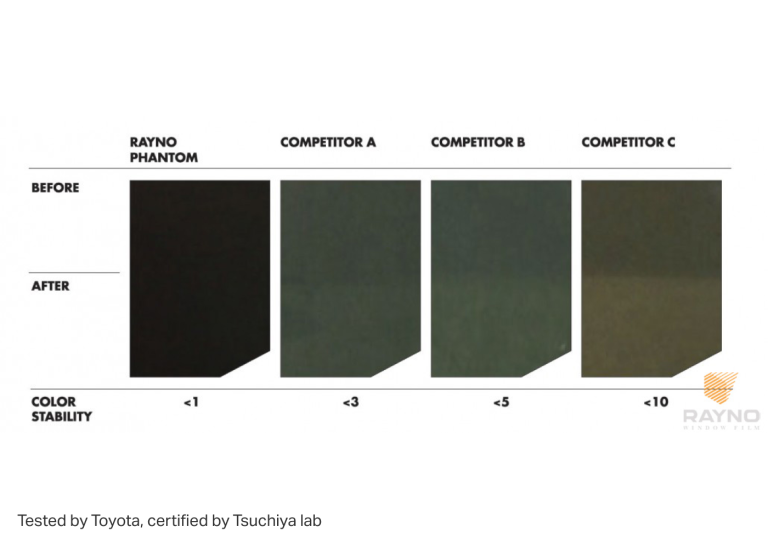
Rayno Phantom film is dye-free and metal-free, with fading under 1%, so it holds its colour on clear or factory-tinted glass.
Find out what your glass needs
Not sure how dark your factory glass already is, or which film would keep it legal? Visit us at 45 Berriman Drive, Wangara or Unit 6/1780 Albany Highway, Kenwick, Monday to Friday 8am-5pm or Saturday 8am-2pm. Phone 0482 689 885 or send an enquiry for a quote.