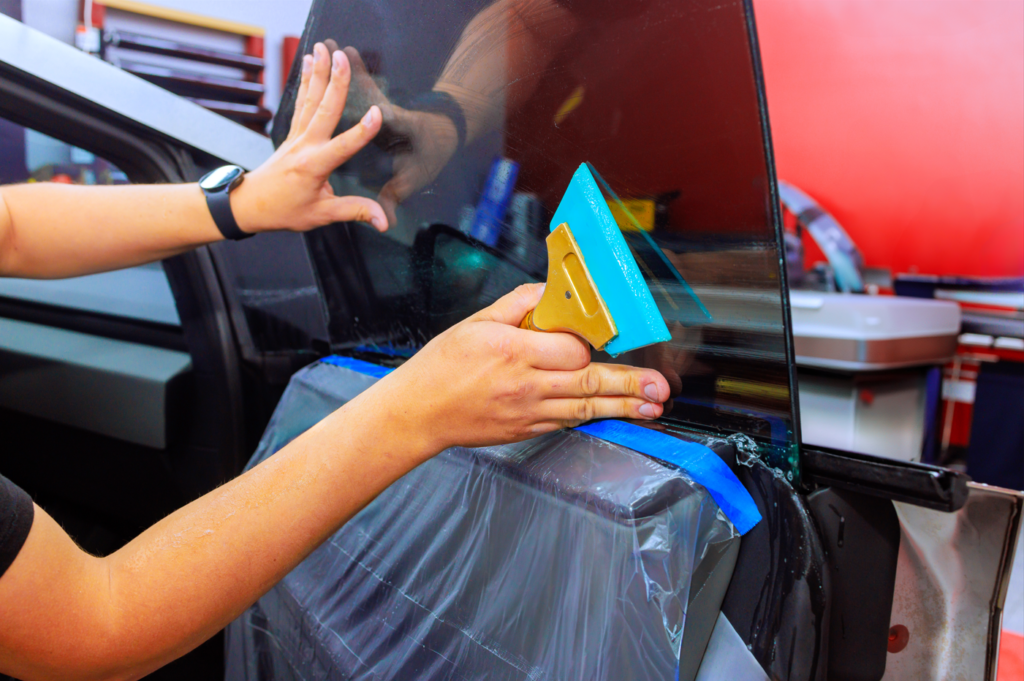
On tinting day, your car is cleaned, the film is cut and shaped to each window, then applied to the inside of the glass and squeegeed into place. Most cars take 2-4 hours at Trident. Afterwards, the windows stay up for 3-5 days while the film cures, and the slight haze you might notice is normal.
If you’ve never had a car tinted, it’s fair to wonder what actually happens once you hand over the keys. Knowing the steps makes it easier to plan your day, ask the right questions and understand why the first week matters so much. Here’s a walk through a typical professional tint job, from choosing a shade to driving home.
Before the day: choosing a film and shade
The two big decisions are the type of film and how dark you want it.
Film type. Trident offers ceramic, carbon and dyed films. The premium option is Rayno Phantom, a nano carbon ceramic film that comes in S5, S7 and S9 grades. It’s dye-free and metal-free, rejects up to 99.9% of UV, and the Phantom S9 rejects up to 93% of infrared heat. You can compare the grades on the ceramic tint page.
Shade. In WA, the Department of Transport sets the limits:
| Window | Minimum light allowed through (VLT) |
|---|---|
| Front side windows | 35% |
| Rear side windows | 20%, when the vehicle has exterior mirrors on both sides |
| Rear windscreen | 20%, when the vehicle has exterior mirrors on both sides |
| Windscreen | Tint only in the top band |
Reflectance must be no more than 10%. VLT is measured through the glass and film together, so cars with factory privacy glass need a little more thought. Trident fits WA-legal shades, and the window tinting laws guide explains the rules in more detail.
What happens when you arrive?
Most tint jobs follow the same basic order, whatever the car.
1. A look over the glass
The installer checks each window for chips, scratches and old film. Existing tint that’s bubbled, faded or purple has to come off before new film can go on. Trident can remove old tint, but it adds to the job, because the old adhesive has to be cleaned off completely.
2. Cleaning
This is the step that decides how clean the finished result looks. The inside of each window is washed and scraped, the edges and seals are cleaned, and any dust is removed. A single grain of sand trapped under film shows up as a small bump.
3. Cutting the film
Film is cut to the shape of each window, either by hand on the outside of the glass or using a pre-cut pattern. Side windows that wind down are usually cut so the film sits just below the top edge, where it can’t catch on the seal.
4. Shaping the rear windscreen
Rear windscreens curve in two directions, and flat film doesn’t follow that shape on its own. Installers lay the film on the outside of the glass and use a heat gun to shrink it until it sits perfectly flat against the curve. It’s slow, careful work, and it’s one of the main reasons a rear windscreen is harder to do well than a side window.
5. Applying the film
The glass is wet with a slip solution, the liner is peeled off the film, and the film is floated into position on the inside of the window. The installer then squeegees out the water from the centre outwards, working towards the edges. On the rear windscreen, care is taken around the demister lines.
6. Final check
Edges are checked and pressed down, and the glass is wiped over. Some installers leave the car for a short while so moisture can start to escape before you drive off.
How long does it take?
Most cars take 2-4 hours. The job tends to sit towards the longer end when:
- old tint has to be removed first
- the car has a lot of glass, such as a wagon, people mover or large SUV
- the rear windscreen is steeply curved
- you’re tinting extra glass, such as rear quarter windows or a sunroof
With a few hours involved, it helps to plan the rest of your day around the booking.
What’s normal straight after tinting?
New film can look a little different for the first few days, and that’s expected.
- Slight haze or a milky look. This is moisture still trapped between the film and the glass. It clears as the film cures.
- Small water pockets. These usually shrink and disappear on their own, faster in warm weather.
- A faint dotted edge on the rear windscreen. Many rear windows have a black dotted border, and film can’t sit perfectly flat over the dots, so a slightly lighter edge there is common.
What isn’t normal is film peeling at the edges, large bubbles that don’t shrink after the curing time, or dirt and hairs trapped under the film. Those are worth getting checked.
How do you look after the film in the first week?
Keep the windows up for 3-5 days. Winding them down too early can catch the bottom edge of film that hasn’t bonded yet. When it’s time to clean the glass, use ammonia-free cleaners and a soft microfibre cloth, because ammonia can damage tint over time.
The window tint aftercare guide goes through the full routine, including washing the car and what to do in a car park boom gate or drive-through.
Frequently asked questions
Can I drive the car straight after it’s tinted?
Yes. You can drive home the same day. Just leave the windows up for 3-5 days and avoid cleaning the inside of the glass until the film has cured.
Does tint go on the inside or outside of the glass?
Window tint goes on the inside, where it’s protected from weather and car washes. The film is only placed on the outside briefly while it’s cut and shaped.
Do I need to empty the car before tinting?
It helps to clear the door pockets, rear parcel shelf and anything stuck to the windows, so the installer can reach the glass and the edges easily.
What if I’m not sure which shade is legal on my car?
Factory privacy glass and different vehicle types can change what’s allowed. The Trident FAQs cover common questions, and Trident fits WA-legal shades.
Book your window tint
Ready to book? Trident has two workshops: 45 Berriman Drive, Wangara and Unit 6/1780 Albany Highway, Kenwick, open Monday to Friday 8am-5pm and Saturday 8am-2pm. Call 0482 689 885 or see the full range on the window tinting page.